

Facing the New Year with Courage and Determination
ven though the global situation is, rightly, deeply worrying and many people are watching an increasing number of crises unfold with disbelief, we refuse to give up in 2026. Two crises in particular deserve far more attention than they currently receive, as they are existential in nature: the destruction of biodiversity and human-driven climate change.
If we fail to stop the collapse of life’s diversity and stabilize the climate, all other crises will ultimately become unmanageable. Large-scale restoration and reconnection of tropical rainforests are absolutely central to addressing both challenges. These forests are indispensable habitats for countless species and play a crucial role in stabilizing the global climate.
This is especially true for regions such as Borneo, where biodiversity is exceptionally rich yet severely threatened, and where forests store enormous amounts of carbon. That is why, for the past 15 years, we have focused our work primarily in Sabah, where we are making tangible and lasting contributions to biodiversity conservation and climate protection.
What follows is our review of the year 2025.
Our Approach Works
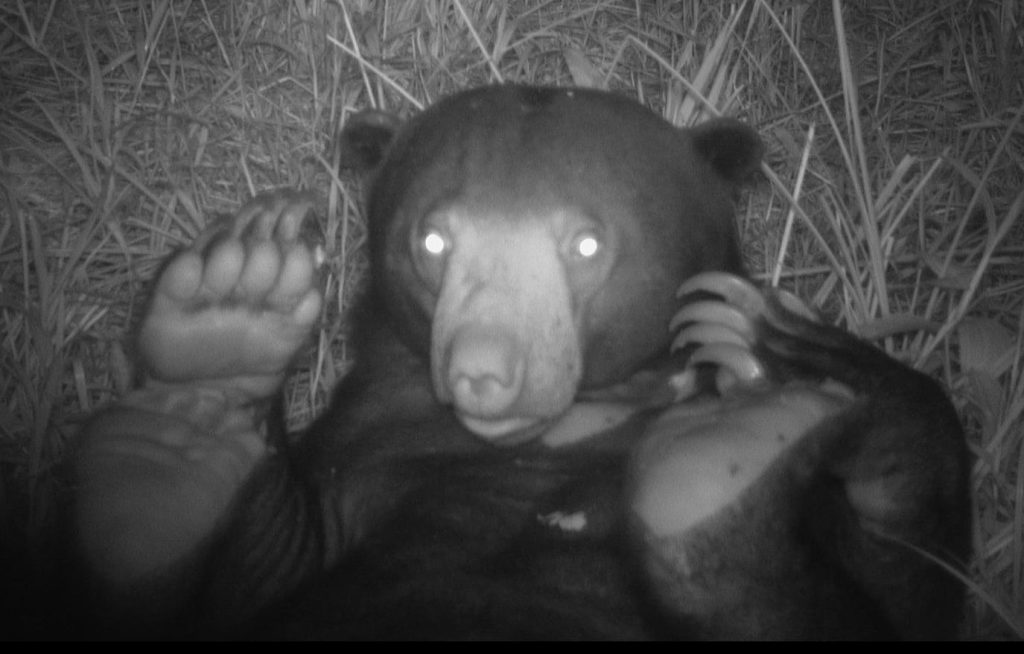
RFF camera trap image (2025): Sun bears are back and clearly feel at home on our reforestation site in Tabin.
Based on our own experience, we can now confidently say that it is possible to transform treeless monocultures into near-natural forest within a decade, creating habitats that once again attract and sustain a wide range of wildlife.
In 2025, we were once again delighted to observe how quickly wildlife returned to our reforestation areas. This includes highly endangered species, some of which number only a few hundred individuals worldwide.
On former plantation land that we were able to acquire and integrate into the Tabin Wildlife Reserve, camera traps recorded six different Malayan sun bears in 2025, including two females with cubs. In 2023, we had documented only a single individual, and before that none at all. In addition, Borneo elephants, humpbacked storks (possibly fewer than 300 individuals worldwide), lesser adjutants, clouded leopards, and many other species were recorded. And all of this after just five years of reforestation.
In northern Tabin, where we created the only forest connection to adjacent forest areas back in 2012, the canopy closed in 2024. Since then, we have been hearing gibbons singing in the northern areas again. As gibbons can only move from tree to tree, this is clear evidence that the corridor is functioning.
The creation of small water bodies has also proven highly effective:
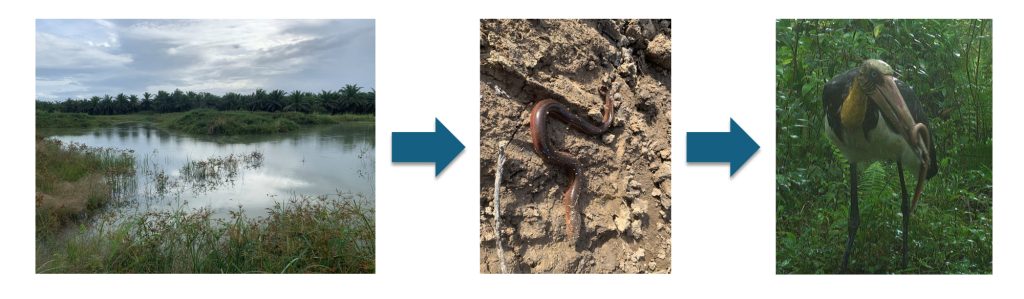
Pictures above:
A lake created by RFF in Tabin in 2022 now supports eel populations that are preyed upon by endangered species such as the lesser adjutant stork. (All images are from our project area in Tabin)
No Highway Through Tabin
One of the most significant successes of the past year was the final cancellation of plans by the Sabah government to build a new highway through our project area. This project would have caused irreparable damage and almost certainly led to the extinction of entire species. Together with many other organizations, we had actively opposed these plans for years.
Expanding Tabin Once Again in 2025
At the end of 2025, an additional 32 hectares of former plantation land in the Tabin–Kulamba wildlife corridor, financed by RFF, were officially integrated into the Tabin Wildlife Reserve.
Since 2017, we have now acquired nearly 100 hectares of strategically vital land for conservation, investing close to EUR 1.2 million. While this may seem like a relatively small area, it connects over 200,000 hectares of key habitats essential for the survival of Borneo’s threatened flora and fauna. The location of these parcels could hardly be more effective.
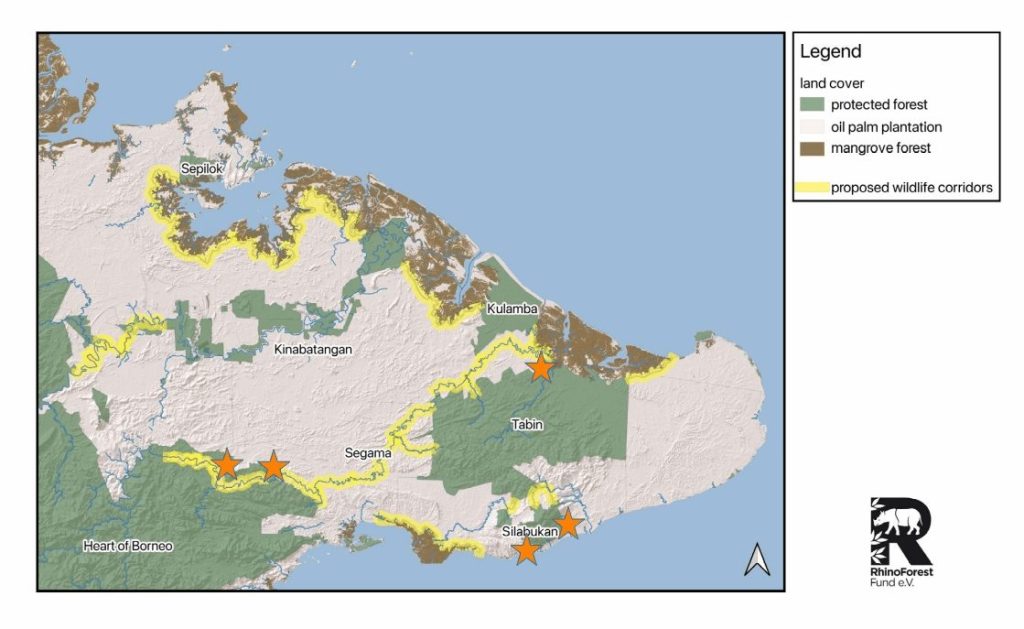
Our connectivity vision for eastern Sabah:
shown in yellow are newly proposed forest corridors; shown in orange are active RFF reforestation areas. The two stars on the left mark our reforestation sites in Bukit Piton; the three stars on the right indicate the reforestation sites in Tabin and Silabukan.
.
A Vision for Connectivity in Eastern Sabah
Our vision for systematically reconnecting the remaining lowland rainforests of Sabah is gaining increasing support. In 2025, we were able for the first time to contribute our proposals for new wildlife corridors directly to long-term regional planning processes. Our suggestions, including reversing landscape fragmentation by relocating certain road sections into tunnels and acquiring and restoring strategically important land parcels, are now being seriously discussed by key planning authorities.
Income and Use of Funds in 2025
After revenues of just under EUR 205,000 in the previous year, donation income increased again in 2025 to approximately EUR 388,150. At the same time, costs are rising due to the expansion of project areas and the resulting need for additional staff. Further essential land purchases also urgently require funding, meaning our financial situation remains challenging.
The majority of income once again came from the strong support of BOS Germany and Zoo Leipzig. Contributions from private individuals, companies, foundations, and supporting members reached approximately EUR 84,000, the highest level we have ever seen, which gives us reason for hope.
Total expenditures in 2025 amounted to approximately EUR 356,500. 89.29% of donated funds were invested directly in conservation measures in Sabah, including project management. 7.88% were used for administrative costs, and 2.85% for travel expenses.
Specifically, our active reforestation areas in Tabin, Silabukan, and Bukit Piton were expanded from 125 hectares to approximately 140 hectares. In the Bukit Piton Forest Reserve, an additional 615 hectares were treated to free young trees from invasive overgrowth, supporting the re-establishment of a closed canopy in this severely degraded forest. We estimate that thousands of trees were saved from dying as a result of this intervention.
Our camps in Tabin and Silabukan were further improved, and the lake in Tabin, which had been heavily affected by invasive plant species, has been undergoing restoration and expansion again since late 2025.
There Is Still Much to Do
The map above clearly shows how much work still lies ahead. Every donation to RFF is translated as directly as possible into land acquisition and forest restoration. The more support we receive, the more areas we can turn into wildlife refuges before it is too late for even more species.
Once again, heartfelt thanks for your continued and future support!
The RFF Team, January 2026